See your digital life clearly, what it's giving you, what it's costing you, and your kids' too.
The first beta is live and in testers' hands. Join the queue and we'll invite you in with the next wave. Built privacy-first, no spam.
Social media is engineered for engagement. AI is accelerating dependency. Yet we have almost no useful way to understand what our digital behaviour is telling us about our attention, relationships and wellbeing, or whether any of it is making our lives better or worse.
of your waking life is now spent on a screen. You rarely know what that time was actually made of.
of adults sleep worse because of bedtime screen use, rising to 46% in under-25s. None of us are immune.
higher risk of depression in adolescents for each extra hour spent on social media each day.
Digital behaviour is a powerful, largely untapped signal of human wellbeing. Your devices already capture the patterns. ThirdLife turns them into insight that helps you, and your family, live better.
Not a screen-time counter, but a read on what that time is actually doing for you.
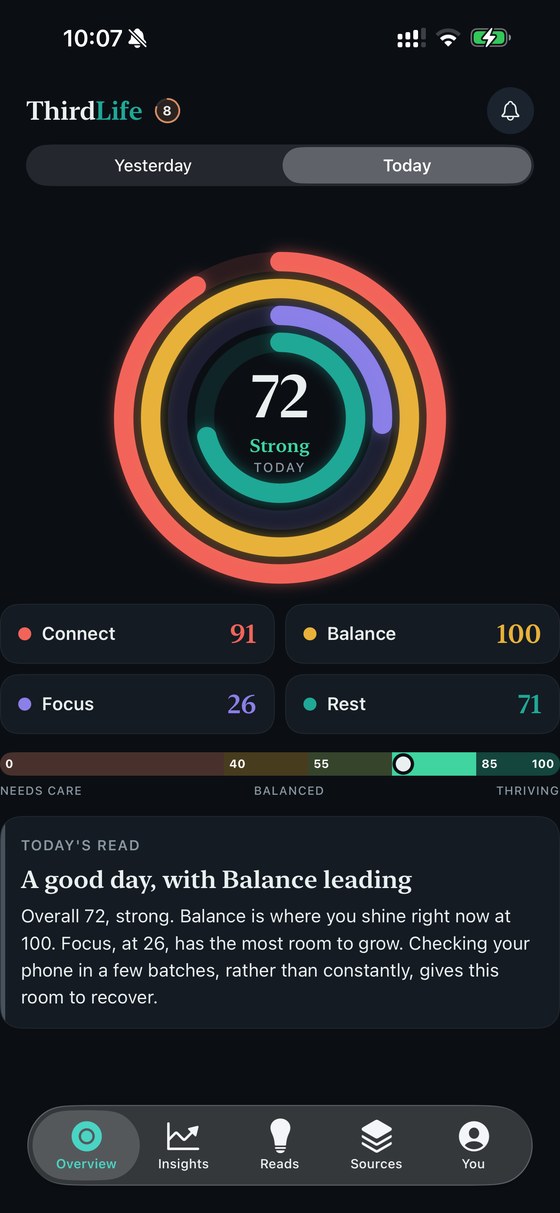
Your whole day distilled into four rings, Connect, Balance, Focus and Rest, and one honest overall score. Not how long you were on your phone, but what that time was actually doing for you.
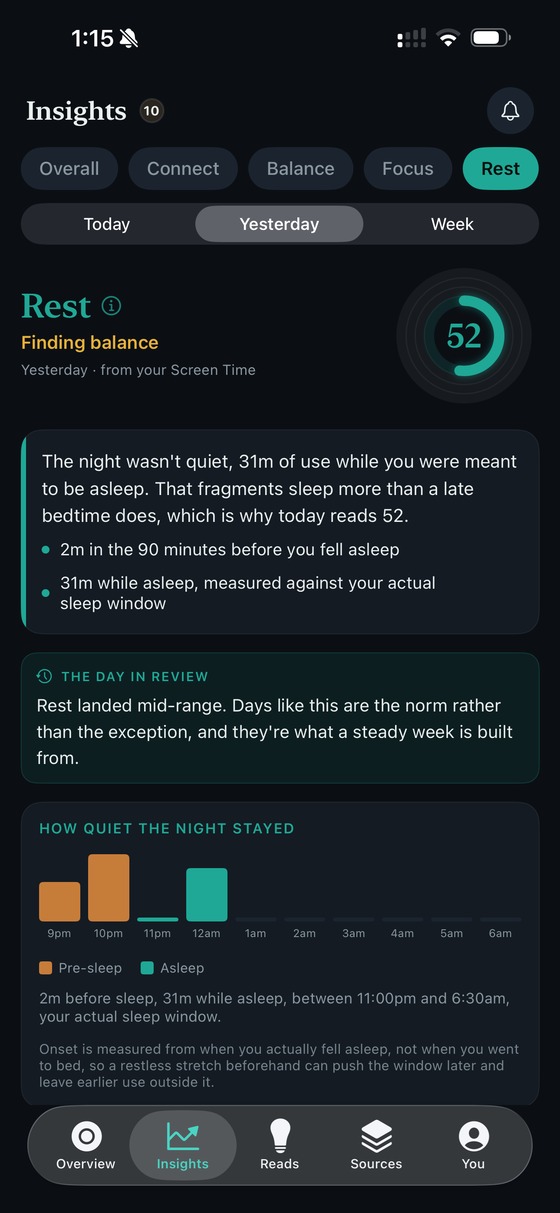
See it below ↓Every score comes with the "why" behind it. See what's lifting each ring and what's quietly draining it, so the number is never a mystery and always tells you where to look.
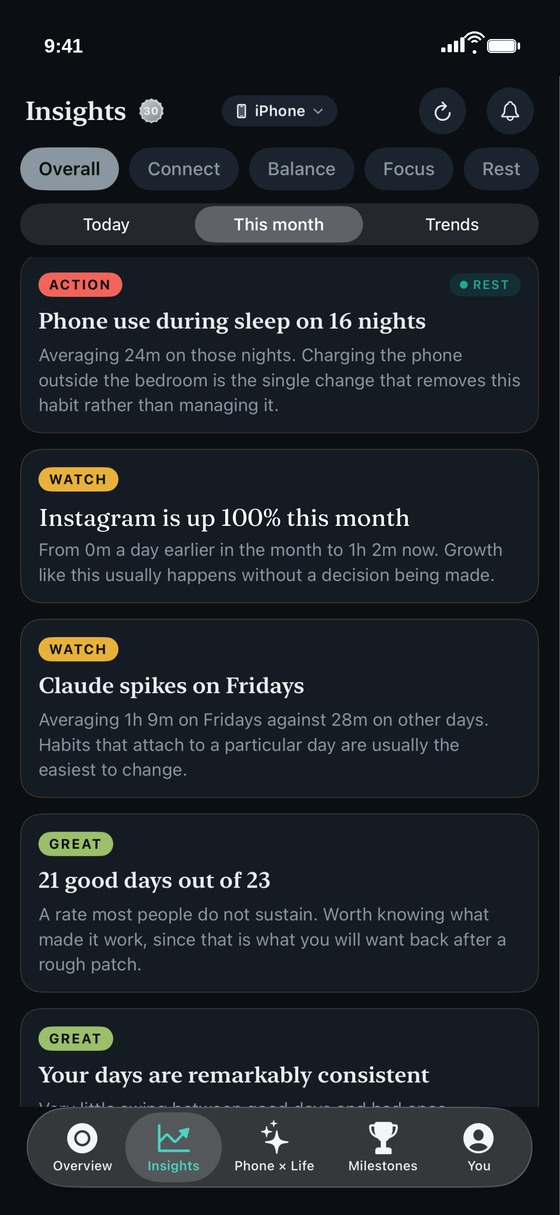
See it below ↓The patterns you'd never spot yourself, surfaced in plain language and graded by how much they matter. Your screen time, finally telling you something instead of just counting.
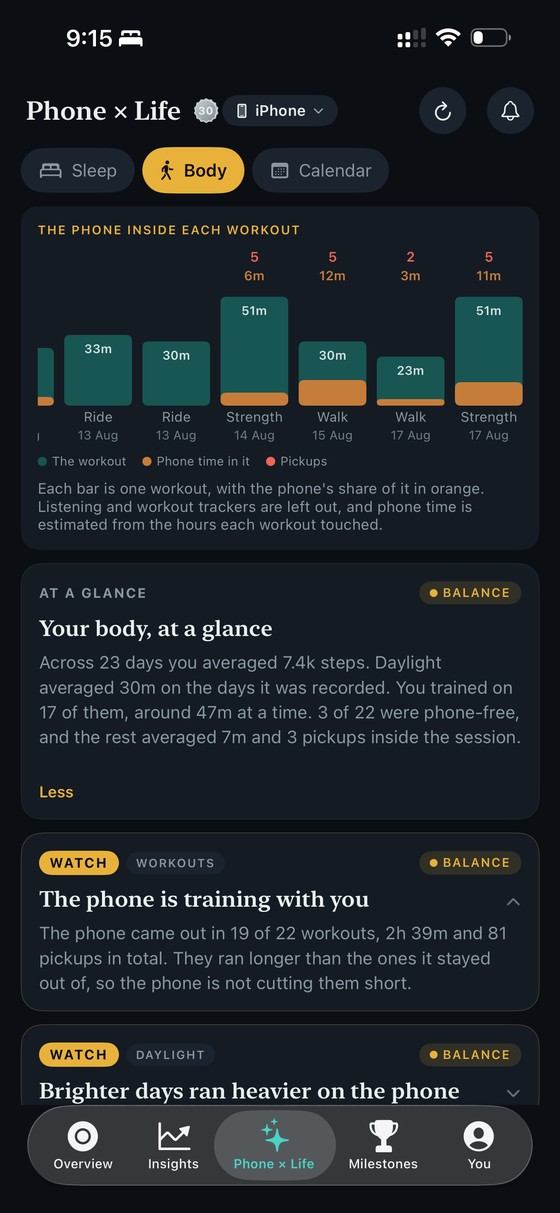
See it below ↓Everything else looks at your phone on its own. This looks at your phone next to the rest of your life, starting with your sleep and your calendar. On the nights you were on your phone late, did you sleep less? On your busiest days, did your attention hold? Connect Apple Health and your calendar and the comparisons begin, with more of your life to come.
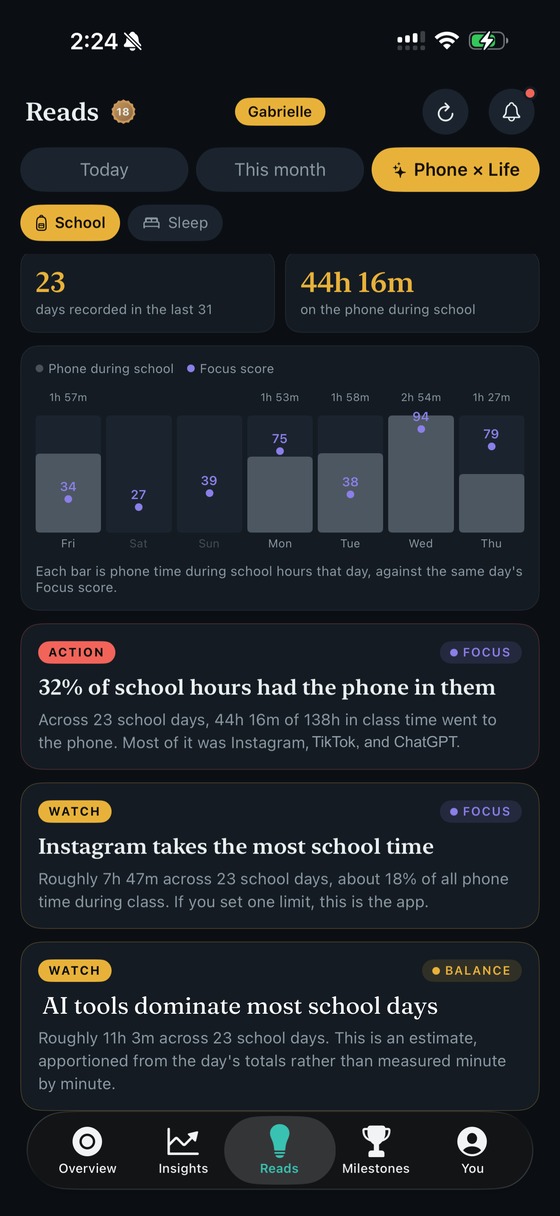
See it below ↓The same app on your child's phone, with the full picture rather than a watered-down version. You set the limits, the sleep window and school hours, locked with your passcode. Then you look at it together.
See it below ↓Seeing is half of it. Limit a single app or a whole category like social media, with daily totals and before-sleep limits that either stop you at the line or send a gentle nudge, as hard or as soft as you want them. ThirdLife also suggests limits for the apps that are constantly heavy.

Connect, Balance, Focus and Rest, each scored out of 100 and rolled into a single daily score, filling toward gentle targets that reset each day. A clear, unshaming read on the things that shape your digital wellbeing, with a plain-language note on what led the day. Targets are being calibrated with behavioural-science input, not picked at random.
Tap any ring to see how it's tracking, today, yesterday or across the week. Insights shows what's lifting the score and what's draining it, with trends and charts, and the single change most likely to help, in plain words rather than raw numbers.


ThirdLife turns raw screen-time signals into intelligent findings you can act on, graded so you know what's worth your attention and what's already going well.
Your screen time only means something in context. Phone × Life compares the nights your Rest score was low against the nights it was high, and shows you what your sleep actually did on each. How long you slept, how often you woke, how long it took to reach deep sleep, when you went to bed. Then it does the same for your calendar and your commitments. Sleep and calendar are where it starts, not where it ends: as more sources connect, more of your life becomes something your phone can be read against.
These are patterns that moved together, not proof that one caused the other. ThirdLife tells you what it found and lets you decide what it means.
You set ThirdLife up on your child's phone, the same app you use yourself, with the full picture rather than a watered-down version. You set the limits and the sleep and school hours, and lock them with a passcode. Then you look at it together.
Nothing comes back to your phone, because nothing should. This is a conversation you have with them, not a report you read about them.

Their screen, not a remote view. Settings are locked with your passcode; everything else is theirs to see.
Setup takes a minute. It starts with the same screen-time signals your phone already collects, and anything deeper is unlocked only with your explicit consent. Adding a child's device works the same way, with their awareness.
Everything runs on the device. None of your screen-time data or insights ever leave the phone.
Set up a child's phone and they see everything you see. The app is visible, they know it is there, and only the settings are locked. There is no hidden view and nothing is sent anywhere.
The four dimensions are drawn from the wellbeing literature, and the scoring is designed rather than guessed. We are working with researchers to test how well it holds, and we would rather say that plainly than overstate it.
A tool designed to be needed less over time. The opposite of the apps it helps you understand.
Our first cohort is already using ThirdLife. We're opening more places wave by wave. Join the queue and we'll invite you in, and your family if you want it.
Join the queueBuilt privacy-first. No spam, just your invite when a place opens.
Building this with you. If there's something you'd love ThirdLife to help you understand, for yourself or your family, tell us at info@thirdlifeapp.com.